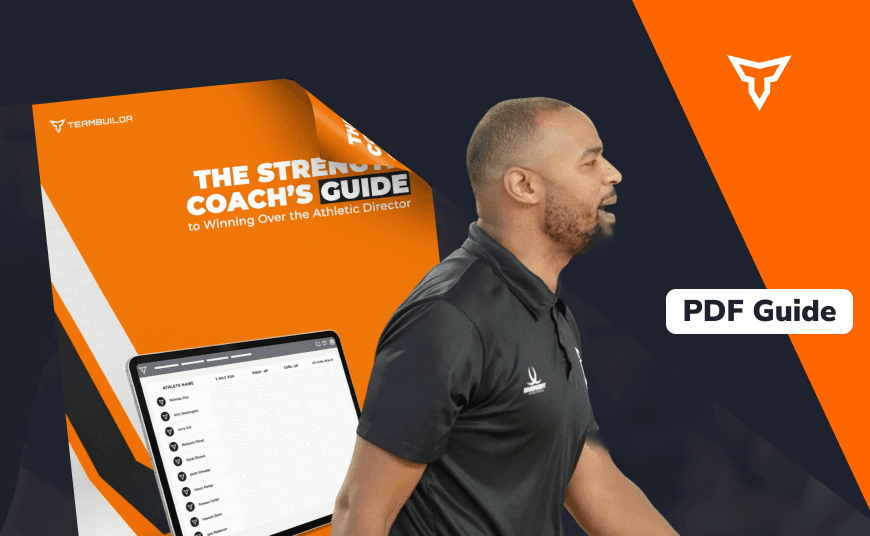
A Strength Coach’s Guide to Winning Over the Athletic Director
Getting an athletic director to say yes. How to frame what you do in the language administrators use, what they are actually weighing, and how to build the case before you need the budget.
What you’ll learn
- Understand the economics an athletic director is actually working with
- Make the case for strength work in terms of students, not equipment
- Show the knock-on effect across the rest of the athletic programme
- Build the relationship before the budget conversation, not during it
Yours free
We’ll ask who you are once. After that the free library is open, for good.
Yours free
We’ll ask who you are once. After that the free library is open, for good.
Inside the guide
7 pages
The first 2 pages exactly as they appear in the PDF. Select any page to see it full size.
- +5more pages
From the opening pages
Let's start from the beginning: Every athletic director is in charge of evaluating the economics behind their athletic program. This will include the salaries they decide to pay positions in the athletics department. While athletic coaches are necessary for competing, other positions sometimes must prove their return-on-investment. Understanding the economics behind your position will help you see “eye-to-eye” with your AD.
Convincing cash-strapped school districts that a strength and conditioning salary makes sense is no slam dunk. "Expense is an issue," says Mike Nitka, Director of Strength and Conditioning and
a Physical Education Instructor at Muskego (Wis.) High School, who puts an S&C coach's salary at the level of a starting teacher — $30,000 to $35,000. "Districts do not seem to value this position, and many try to combine two positions."
Strength coach Liane Blyn widens the salary range from $20,000 to $55,000, with stipend positions falling somewhere between $900 and $7,000. In an era of scholarship-seeking parents willing to pay for private personal training, a high school athletic department can actually recoup some of its investment in a strength and conditioning coach. "The goal for the offseason fall, winter and spring workouts wasn't necessarily to make money for the department; it was to offer a great service
to our student-athletes. The small charge covered the stipend for the strength coach," says Blyn
of their school’s approach, adding, "Our summer program cost was $150 and brought in a good chunk of money to the department — more than $100,000 — and after paying the staff there was a net of approximately $60,000."
TeamBuildr
Run this with your athletes.
The programming, the tracking and the reporting in one place, built by coaches who write the same sessions you do.
Read next
Also in Leadership & Career

Audio · 49 min
FreeEpisode #21: Empowering the High School Strength Coach with Gary Schofield
Gary Schofield on high school strength and conditioning: building a programme that survives budget cycles and staff turnover, and making the case for the role to people who have never had one.
More in The Athletic Department

PDF · 4 pages
Free7 Athletic Directors Discuss Their Strength Programs
Seven athletic directors on what they look for in a strength program, how they judge whether it is working, and what makes them fund one over another. Useful before your next budget conversation.
For High School & PE

Read on the blog · 13 min
FreeStarting a Strength & Conditioning Program from Scratchopens blog.teambuildr.com in a new tab
You have the job and not much else. Equipment on a budget, winning over sport coaches, setting standards early, and what to fix first.

Interactive form
Free · sign upSample Grant Proposal for S&C Software
A complete, fillable grant proposal for strength and conditioning software and hardware. Five narrative sections are already written: your project, the problem, the timeline, who it reaches, and the budget. Change six details and it is yours.
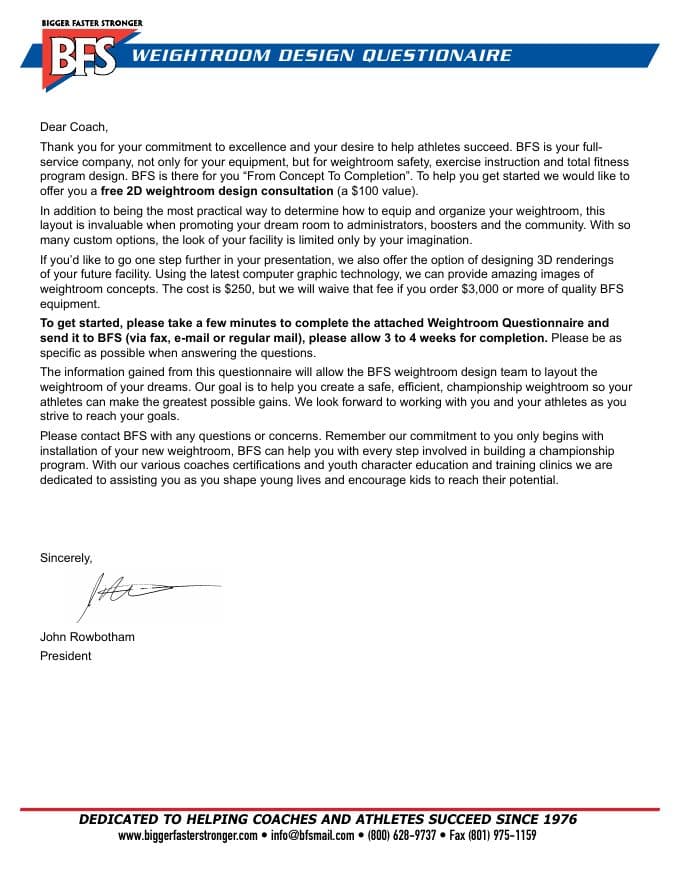
BFS Weight Room Design Questionnaire
The BFS weight room design questionnaire — the room, budget, and program questions that start a weight room design consultation.

Video · 39 min
FreeAutoregulation in Long-Term Athletic Development: Meeting Athletes Where They Are - Phil Reichhoff
Level 1 Sample 9-Week Program: Free TeamBuildr webinar with Director of Performance Phil Reichhoff discussing how to program workouts for high school athletes who are constantly growing and maturing. Using Autoregulatory Progressive Resistance Exercise (APRE) to program for high
- Format
- Length
- 7 pages
- Category
- The Athletic Department
- Topics
- Leadership & Career