Summer of Speed
TeamBuildr's guide to speed and conditioning, with twelve embedded video breakdowns. Argues that speed development is most strength coaches' blind spot, then lays out what to do about it, including why the work has to leave the weight room.
What you’ll learn
- Diagnose why your speed work isn't transferring to the field
- Programme acceleration and top-end speed as separate qualities
- Run effective speed sessions outside the weight room
- Fit sprint work into a schedule that's already full
Yours free
We’ll ask who you are once. After that the free library is open, for good.

Yours free
We’ll ask who you are once. After that the free library is open, for good.
Inside the guide
44 pages
The first 4 pages exactly as they appear in the PDF. Select any page to see it full size.
- +40more pages
From the opening pages
With summer quickly approaching, sport performance coaches across the country are turning their attention to designing and implementing effective speed and conditioning programs. For some coaches, this can be a stressful time for multiple reasons. Although we all (should) have the prerequisite knowledge and education to design and implement safe and effective speed or conditioning programs, there is no doubt this area of programming seems to cause the most debate in sports performance. In my opinion, the reasons can all be traced back to an overarching problem in sport performance: lack of resources. Whether it’s due to coaches being spread too thin, lack of space, time, staffing, or just calendar or logistical conflicts, many performance coaches are not getting the same amount of exposure to speed and conditioning work when compared to weight room time. This leads to a large imbalance in expertise and comfort in designing these programs. I’ve had roles where conditioning and speed training are a large part of what we do, and I’ve held positions where I do little to no speed or conditioning training. Let’s look at a few example scenarios to set the stage.
Scenario 1: Lack of Staffing
Division 3 and high school performance coaches are usually one-man shows. This means one coach can be responsible for 20+ programs with little to no support staff. Given the nature of this scenario, the primary focus is often given to the weight room (for good reason). Conditioning or speed development sessions are typically an afterthought. I can only speak from personal experience, but I know this always poses a unique challenge to find ways to implement these critical elements into our programs. Without going too in-depth, coaches are often forced to sacrifice quality for practicality. This may mean having sport coaches run conditioning, offering general conditioning or speed sessions open to multiple sports, implementing it during weight training sessions, or in some cases, offering no training at all.
Scenario 2: Logistical or Time Conflicts
My first experience in the private sector as a performance coach was eye-opening. Coming from the college world where we had our student-athletes year-round to the private world where athletes were in for breaks, summer, or even just a week at times caused major stress when it came to how I was going to incorporate speed training and conditioning. Private sector sport performance coaches are put under the gun during winter and summer breaks to prepare their athletes for both their sport and their return to campus. This means they have to take into consideration things like conditioning tests and collegiate strength coach approaches while trying to best prepare the athlete. Often times this means looking for high return on investment (ROI) activities. Personally, I spent the majority of my time on mechanics as I made the decision these would
have the best carryover and would best protect the athlete from injury. Despite building systems to provide the athlete with the best chance for success, I still found myself conflicted between what I wanted to accomplish and what was practical in the time-frame I was allotted.
Chapters
- 1TEAMBUILDR’S GUIDE TO SPEED AND CONDITIONINGp.2
- 21. INTRODUCTIONp.3
- 32. IS TEACHING SPEED DEVELOPMENT A STRENGTH COACH’S ACHILLES HEEL?p.5
- 43. OH, YOU WANT FAST ATHLETES? TIME TO LEAVE THE WEIGHT ROOMp.9
- 54. ANALYSIS: STRENGTH COACHES SHOULD CONDITION ATHLETES WITH MORE PRECISIONp.13
- 65. THE SINGLE BIGGEST KEY TO DEVELOPING SPEED IN YOUTH ATHLETESp.16
- 76. DESIGNING AND IMPLEMENTING AN EFFECTIVE SPRINT SESSIONp.21
- 87. 3 SLED DRILLS FOR ENHANCING SPEED AND AGILITYp.27
- 98. 7 SIMPLE FIXES TO GET THE MOST OUT OF BOUNDINGp.31
- 109. THE CASE FOR IMPLEMENTING CURVED SPRINTING INTO YOUR PROGRAMp.34
- 1110. MY PLAYERS FAILED THE CONDITIONING TEST: WHAT’S NEXT?p.41
- 1211. CONCLUSIONp.44
Videos in this guide
12 demonstrations linked from inside the PDF. The page number shows where each one is referenced.
Free with sign-up
Watch all 12, and keep the rest of the library open.
12 demos
TeamBuildr
Run this with your athletes.
The programming, the tracking and the reporting in one place, built by coaches who write the same sessions you do.
Read next
Also in Training & Programming
Video · 1 min
Free10-Week Contingency Summer Program
Overview of 10-week program with minimal movements including barbells and DB's - and no Olympic movements. Designed for athletes training outside their athletic facility (globo gym, etc.).
More in Program Downloads
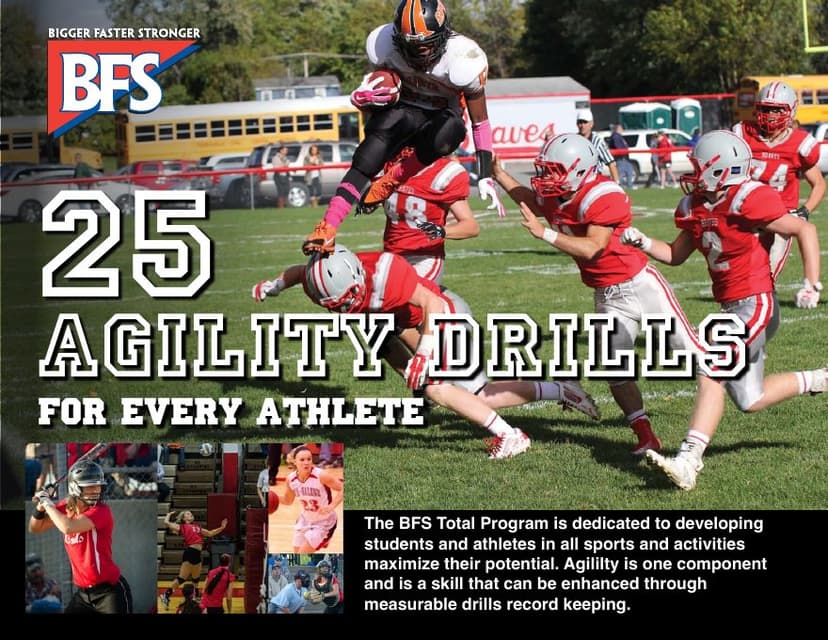
BFS 25 Agility Drills
Twenty-five cone and line agility drills for every athlete, with diagrams — measurable drills built for record keeping, straight from the BFS Total Program.
Also in Speed & Power
BFS Conditioning Program & Endurance Test
The full Total Program Speed and Conditioning booklet: the Dot Drill warm-up, the speed and conditioning programs, and the BFS endurance test in one PDF.

BFS Plyometric Program
The BFS Plyometric Program (2020 edition): ground-based jumping drills that transfer weight-room strength into explosive movement and sports performance.

Read on the blog · 7 min
FreePrivate Facility Summer Training That Delivers: Building More Explosive Athletesopens blog.teambuildr.com in a new tab
Discover how athletes at our private facility made explosive gains during summer training. Using force plates, sprint gates, and structured programming, we tracked real progress in CMJ height, power output, and linear speed from April to July.
Training program
Included with PlatinumFootball Taper
This 3 Week 4 day program is specifically tailored for football players that will be leading into camp. This program should take place after a training phase but before the time that the players will report for training camp. This program still has some speed, conditioning and COD, along with strength training that will allow their body to rest, but also not lose any gains that they may have made during the summer training phase.
- Format
- Length
- 44 pages
- Sections
- 12
- Category
- Program Downloads